Garbo Flatware is the leading manufacturer and exporter of stainless steel cutlery with 30 + Years in supplying tableware.

Garbo Flatware is the leading manufacturer and exporter of stainless steel cutlery with 30 + Years in supplying tableware.
Pulished on Nov. 12, 2026
Two suppliers quote the same dinner fork, and one price is 30% lower. The inquiry only said "stainless steel dinner fork," so nothing in it explains the gap. It could be the steel grade, the thickness, the weight or the finish, and the buyer cannot tell which.
Specifications are what make quotes comparable. They also shape how a set feels in the hand, where it sits in the market and what it costs to produce. Requirements differ by market, so a buyer needs to know which parameters to write down before asking for a price.
Most flatware programs are built from a handful of pieces. The dinner fork is the main table fork and the anchor of any set. The salad fork is shorter and often has a broader outer tine. The dessert fork is smaller still, and some sets use it for cake or starters.
On the knife side, the dinner knife is the standard table knife, found in most hospitality and retail sets. The steak knife is longer with a sharper blade, and is sometimes sold separately. The butter knife is short with a blunt blade, made for spreading rather than cutting.
If you are building a range, look at Garbo's dinner knife and stainless steel fork categories for the item types it manufactures.
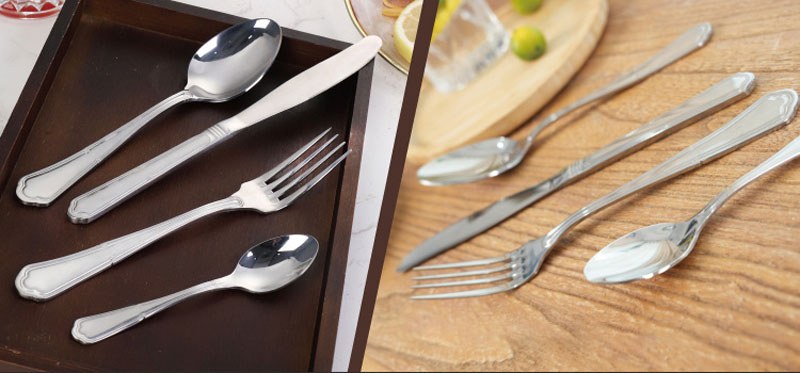
Four measurements belong in every inquiry. Length is the overall length of the piece. Width is usually taken at the widest part of the bowl, tine head or blade. Thickness is measured on the steel stock, and it can differ between the handle and the head. Weight is the single-piece weight.
The list below shows common design reference ranges for length.
Dinner Fork: 190–210 mm
Salad Fork: 160–180 mm
Dessert Fork: 140–160 mm
Dinner Knife: 210–240 mm
Steak Knife: 220–250 mm
Butter Knife: 150–170 mm
These are common design reference ranges, not an international standard. Actual sizes vary by pattern and market. For width, thickness and weight, the safest approach is to approve a sample, record its measurements and agree a tolerance in writing.
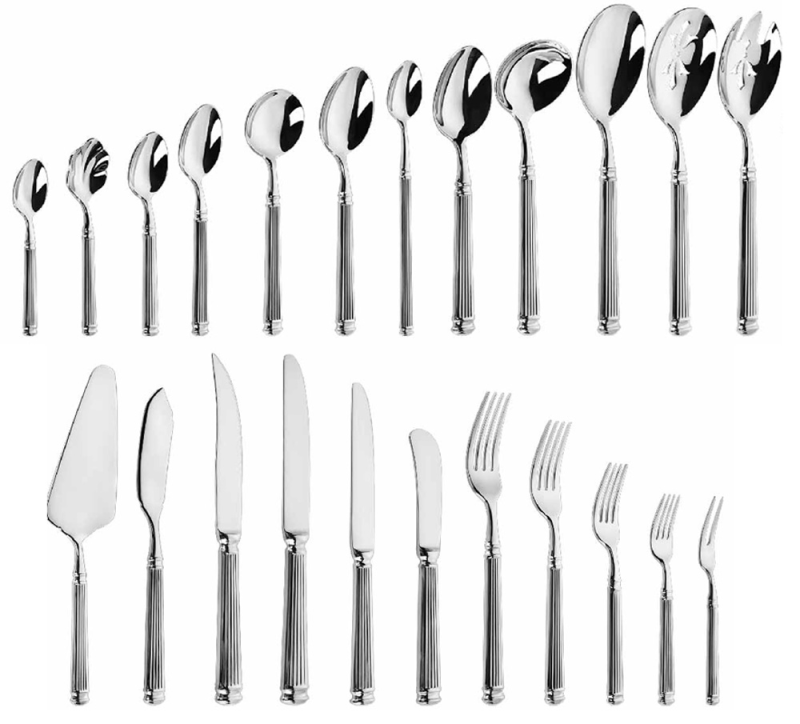
Grade affects price, corrosion resistance, hardness and positioning, so it should be named in the quotation.
304 offers good corrosion resistance and is commonly used for mid-range to premium cutlery.
430 is common in economy cutlery and in some accessories. It generally costs less than 304.
410 is harder and is often used for knives and blades, where edge performance matters.
A set may combine grades. A knife may have a hardened blade and a different handle material, so ask for the grade of each part rather than one grade for the whole set. Whichever grade is quoted, ask for confirmation in writing and match it against the samples.
Thicker stock resists bending better, particularly in the knife handle and fork neck. Weight changes how the piece feels in the hand, and buyers often read heavier cutlery as higher-end.
This is why two forks that look the same can carry very different prices. The difference is often steel grade, thickness and weight, and none of them are obvious from a photograph. A thinner, lighter piece uses less material and costs less, which suits some programs and not others.
The right level depends on the market. Compare candidate samples side by side against your target product rather than relying on a number from a data sheet, and record the approved weight and thickness in the order specification.
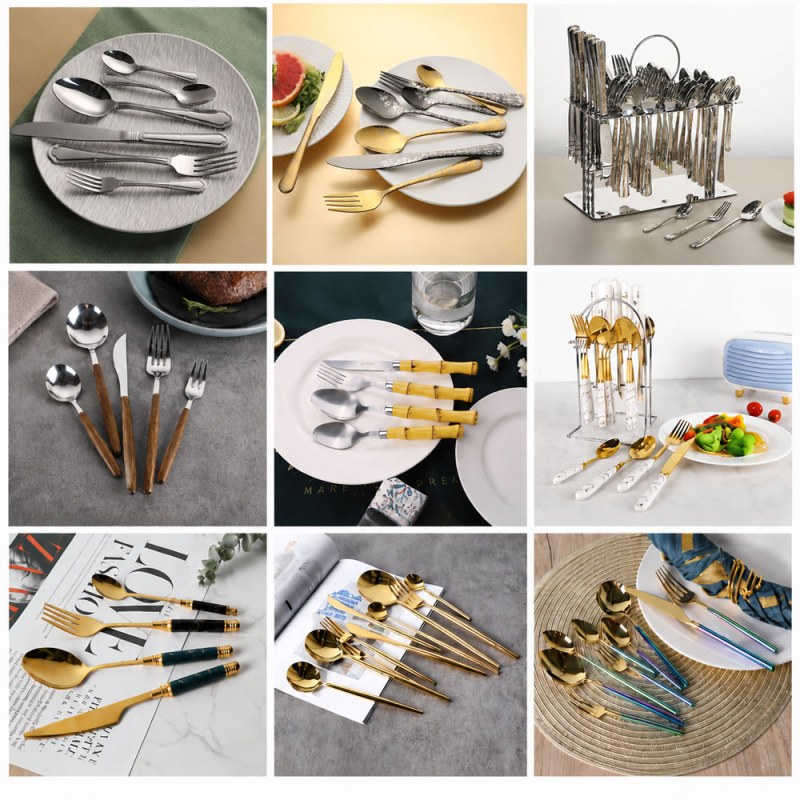
Finish changes appearance, handling and cost.
Mirror polish gives a bright reflective surface and is widely used in classic sets.
Satin finish has a soft brushed look that shows fewer fine marks.
Matte finish is non-reflective and suits modern table settings.
Hammered finish adds a textured pattern for a decorative look.
Engraving adds a logo or pattern to the handle.
PVD coating produces colours such as gold, black or rose gold.
Garbo's silver flatware set and gold and coloured flatware pages show these two ends of the range. Each finish may affect cost and lead time, so confirm both with your supplier. Ask for a sample under the same finish you intend to order before approving volume.
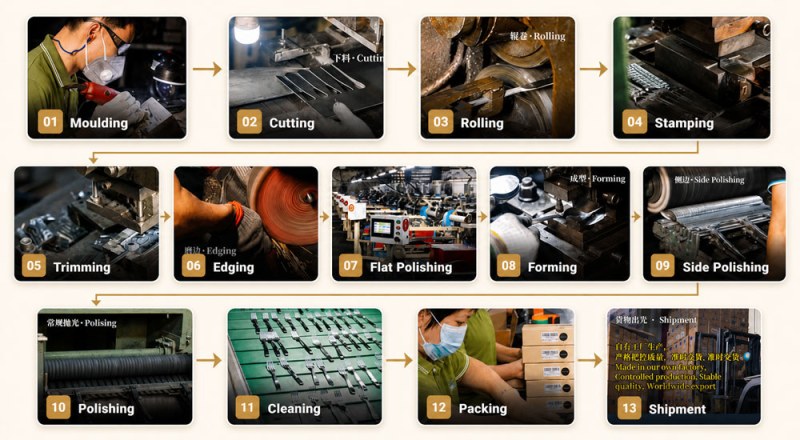
Do not accept a general statement that cutlery is "food grade." Ask for a food-contact safety report that names the product and material, and check which standard applies to your target market.
For corrosion resistance, ask which salt-spray method was used, for how long, and what the pass criteria were. For dishwasher resistance, request cycle testing and compare the appearance before and after. These tests are especially important for coloured or coated cutlery, where surface durability should be verified rather than assumed.
Supermarket and mass retail: focus on cost and practicality. A lighter, simpler piece may be the right answer.
Mid-range to premium retail: weight, thickness and finish carry the most weight in the buying decision.
Hotel and catering: durability under heavy daily use and repeated washing comes first.
Gifts and promotions: appearance and packaging do most of the selling.
A cutlery specification is a purchasing tool. Put the item type, dimensions, steel grade, thickness, weight, finish and tests into the inquiry and the sample approval sheet, and quotes become comparable.
Garbo Flatware is a stainless steel flatware manufacturer in Jieyang, Guangdong, offering OEM/ODM service. To discuss specifications and samples, browse the flatware catalogs or contact Garbo about OEM/ODM development.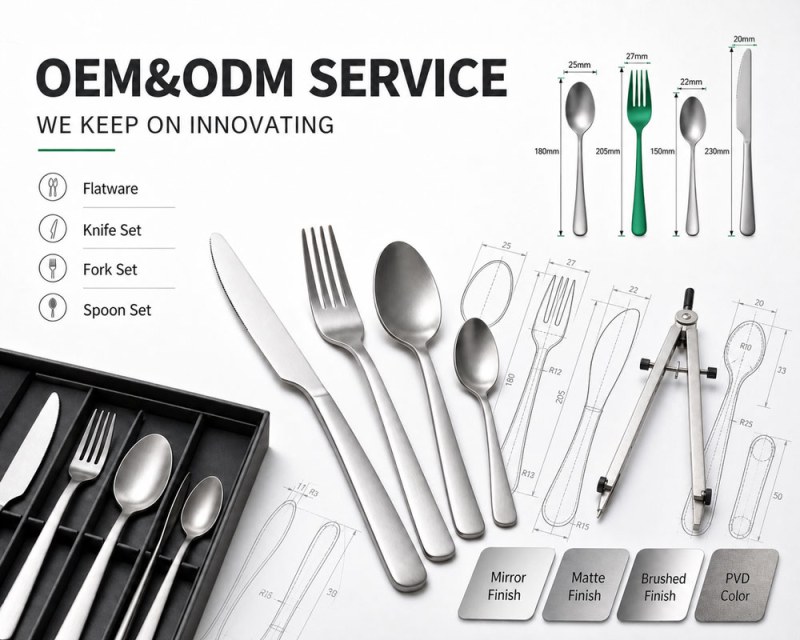


Looking for Flatware Supplier?
OEM&ODM RequestRequest for Quotation?
Get Factory PriceAny Confusion?
Speak With Salesman
We deliver the quality and value your flatware needs, on time and within budget.
Contact UsODM&OEM Service
Our flatware is certified by leading retailers including Walmart, Tesco, Costco, Lidl, Target, and METRO, ensuring the highest quality standards.
Experience seamless service from design to export with our one-stop solutions. Our team simplifying your export process and allowing you to focus on growing your business.
Choose from a range of eco-friendly and customized packaging options to suit your specific needs. Our packaging solutions are designed to protect your products while reducing environmental impact.
Our efficient supply chain ensures timely delivery of your custom cutlery, minimizing lead times and keeping your business operations running smoothly.
Comprehensive support & satisfaction guaranteed.


